
• Home
  • Blog
  • Introducing…
  • Analysis
  • Misc.
  • American
  • Canadian
  • Children’s
  • Christian Literary Criticism
  • Index of Christian Victorian Literature

Christian Victorian Literature

Christian Victorian Literature

Tag Archives: American

“The Lamplighter” by Maria S. Cummins

27 Sunday Sep 2026

Posted by ChristianVictorianLiterature in American

≈ Leave a comment

Tags

American, duty, virtue

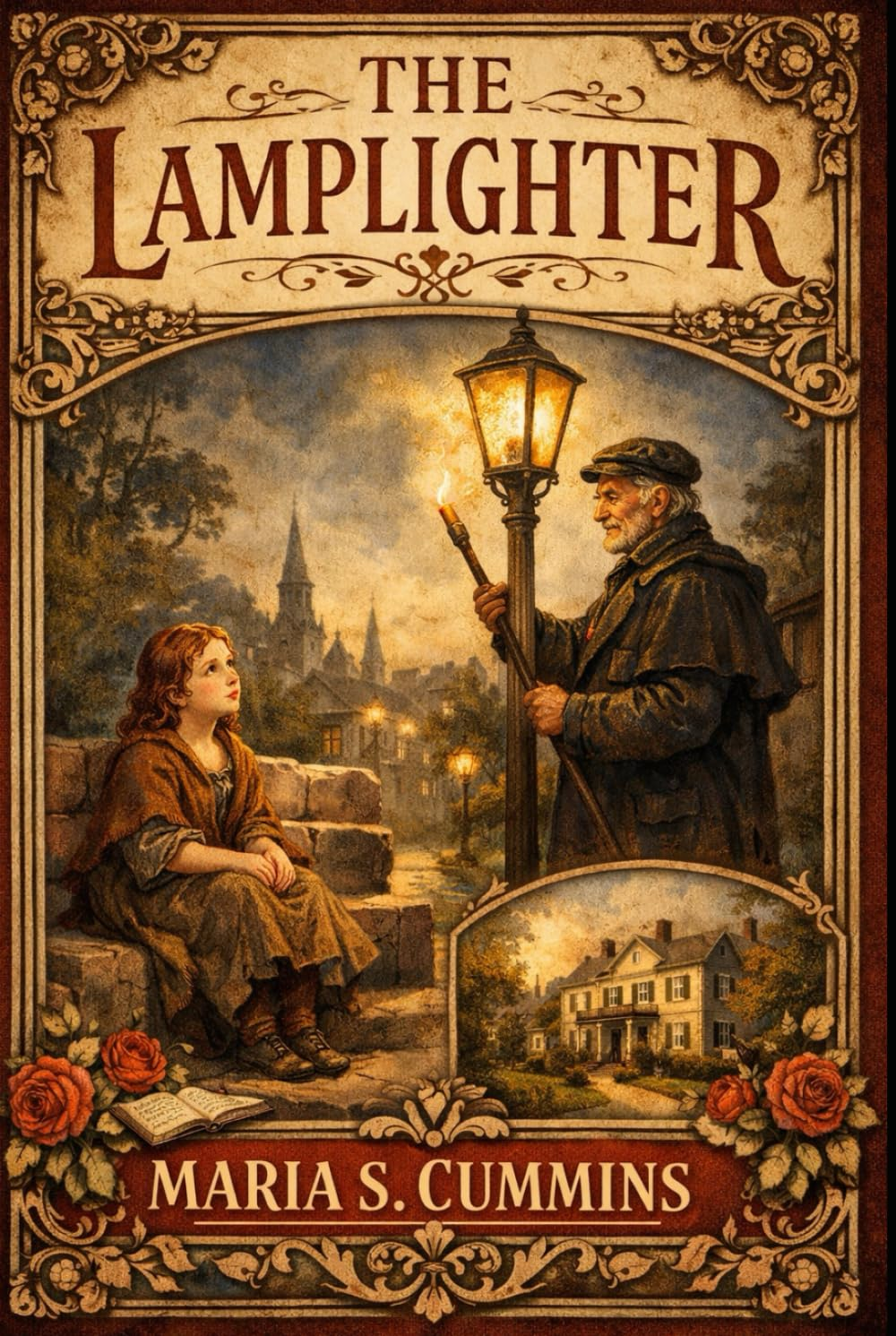
The Lamplighter (1854) by Maria S. Cummins was an immediate sensation in America upon publication, selling 40,000 copies in the first two months, and a hundred thousand within a year. It even achieved success in Europe in several languages. Cummins never attained further success, however, with subsequent novels. She died at age 39, a member of the Unitarian Church. The particular edition I read was published by Lamplighter Ministries, which resurrects old, Christian novels that have fallen out of print for the contemporary reader seeking wholesome and virtuous books. Lamplighter Ministries binds all its books with beautiful, ornate hardback covers that look sturdy enough to withstand years of usage.

The Lamplighter was apparently a favourite among young girls and women, which is no surprise, as it unfolds the tale of a young orphan girl on the streets, Gertrude, taken in by a kind lamplighter, and then by a blind woman, upon the lamplighter’s passing. These two mentors raise Gertrude in the Christian faith and she learns by their example and teaching to overcome her character flaws and grow in Christ-likeness.

To be sure, The Lamplighter is a moralistic novel. It is not incredibly intellectual or literary, but it is a sweet, light read with quickly flowing action that makes it easy to turn the pages. Many amazing coincidences arise in the plot, which will induce either intrigue or cringe, depending on the reader.  The author directs the story with the obvious, overarching moral that trials and suffering sanctify us and draw us to God, if only we will submit to them as the workings of His will and trust that He will bring all to rights for them who love Him.

The issue of duty also prevails in the novel. Nineteenth-century Christians took “duty” very seriously as a Christian responsibility, a virtue I think we do not value as much today. Interestingly, it is Gertrude’s sense of duty to care for her lover’s enfeebled parents that emboldens her to stand up to one of the strong male figures in the novel, her friend Emily’s father, and inform him she will not obey his wishes, and she actually moves out and obtains a job to support herself. This whole move is a stratagem so that the ailing parents will accept her help, so she does not act on her own behalf, but still, she does exercise some agency. Interestingly, it was this sense of “duty” to help others that originated the very first “feminists” in the Victorian Era; the push for the increase of female agency was always couched in terms of Christian duty to help the poor and vulnerable in society.

Share this:

  • Share on Facebook (Opens in new window) Facebook
  • Share on X (Opens in new window) X
  • Share on Pinterest (Opens in new window) Pinterest
  • Print (Opens in new window) Print
  • Email a link to a friend (Opens in new window) Email
  • Share on Tumblr (Opens in new window) Tumblr
  • More
  • Share on LinkedIn (Opens in new window) LinkedIn
  • Share on Reddit (Opens in new window) Reddit
Like Loading...

Introducing “Stepping Heavenward” by Elizabeth E. Prentiss

13 Saturday Aug 2016

Posted by ChristianVictorianLiterature in American, Introducing..., Uncategorized

≈ 2 Comments

Tags

American, Elizabeth E. Prentiss, hymn writer, sanctification, Stepping Heavenward

It is delightful to discover a Victorian hymn writer who was also a novelist! Elizabeth E. Prentiss, who penned the well-known hymn “More Love to Thee,” published several works of fiction, including Stepping Heavenward: One Woman’s Journey to Godliness (1869). In this coming of age story, the protagonist Katharine journals her pilgrimage through the summits and valleys of sanctification, the process by which God uses blessings and trials to shape and refine us into people after his own heart. Although Prentiss was American, her works were widely read throughout the British Commonwealth and translated into other languages; Prentiss was even included in a German anthology entitled A Collection of British Authors.

From beginning to end Stepping Heavenward is infused with the truths of the Christian faith, but three overarching themes govern them all, and all derive from scripture. Firstly, every trial is sent from God to test and refine us, and the choice we make regarding each one – to accept with humility or reject in anger – will either draw us closer to or push us away from God. Secondly, the key to Christian joy is contentment in all circumstances (especially in unfavourable circumstances).  And lastly, everything should be done for the glory of God, by doing it in the spirit of Christ – and not just when praying or visiting the poor. Even when working, shopping or pursuing a hobby we should not act as though a secular/sacred divide separates our lives. All is God’s, and we can choose to bring glory to him every moment.

For another example of Christian literature that aims to inspire readers to act virtuously see Agnes Grey (introduction and analysis).


Share this:

  • Share on Facebook (Opens in new window) Facebook
  • Share on X (Opens in new window) X
  • Share on Pinterest (Opens in new window) Pinterest
  • Print (Opens in new window) Print
  • Email a link to a friend (Opens in new window) Email
  • Share on Tumblr (Opens in new window) Tumblr
  • More
  • Share on LinkedIn (Opens in new window) LinkedIn
  • Share on Reddit (Opens in new window) Reddit
Like Loading...

Recent Posts

  • “The Lamplighter” by Maria S. Cummins
  • “Doctor Thorne” by Anthony Trollope
  • 10 Years of CVL
  • “The Way We Live Now” by Anthony Trollope
  • Introducing “Sylvia’s Lovers” by Elizabeth Gaskell
  • Introducing “Home Education” by Charlotte Mason
  • My Story: A Victorian Healing
  • Christian Victorian Readings for Advent

Enter your email address to follow this blog and receive notifications of new posts by email.

Join 66 other subscribers
Follow Christian Victorian Literature on WordPress.com

Tags

agnes grey Anne Bronte C.S. Lewis Charlotte Bronte class Elizabeth Barrett Browning Elizabeth Gaskell George MacDonald industrial England Jane Austen Jane Eyre literature Lorna Doone marriage mary barton masculinity Nature novel R.D. Blackmore Wild At Heart

BlogCatalog

Books Blogs - BlogCatalog Blog Directory

Blog at WordPress.com.

  • Subscribe Subscribed
    Christian Victorian Literature
    Join 66 other subscribers

    Have a WordPress.com account? Log in now.

  • Christian Victorian Literature
    View site in Reader
    Manage subscriptionsSign upLog in
    Report this content
    Collapse this bar
Loading Comments...
%d